

What does a good laser endpoint actually look like? Watch this.
Get inches away from a real ablative resurfacing treatment and see what students rarely get from a textbook: the pattern on the skin, the immediate response and the clinical details an experienced provider is watching throughout the procedure.
Why does collagen take time to build?
Because collagen remodeling is a process, not an instant reaction. Treatments like microneedling, RF microneedling and resurfacing create a controlled stimulus that tells the skin to repair itself. That kicks off a sequence: inflammatory signals appear first, fibroblasts are activated, new collagen is produced, and then that collagen has to organize, strengthen and remodel. Early collagen is essentially the framework. Over the following weeks and months, it matures and becomes more structured, which is why improvements in firmness, texture and skin quality can continue long after the treatment itself.
TREATMENT STARTS THE PROCESS.
BIOLOGY FINISHES IT.
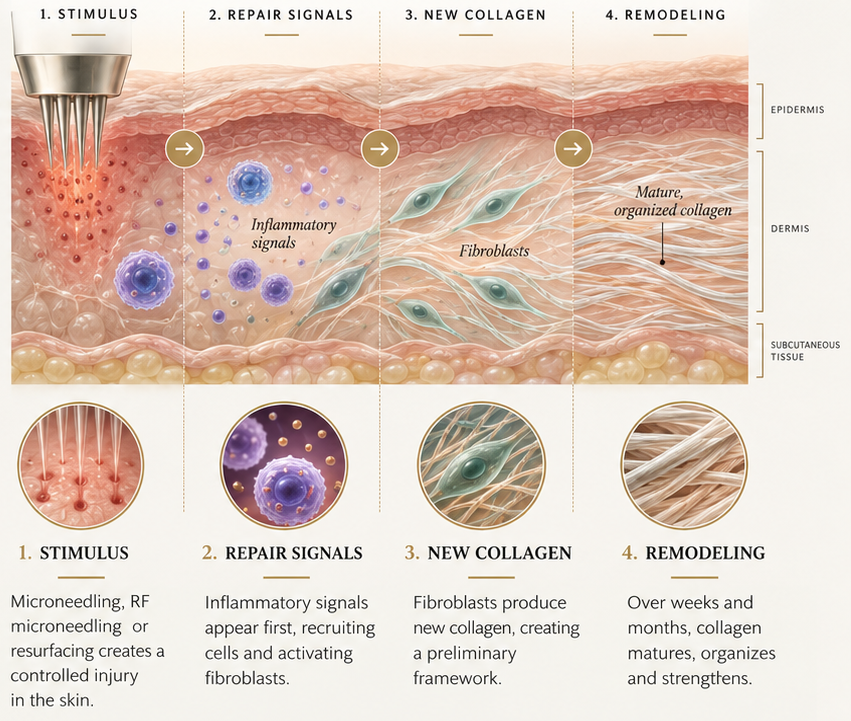
Collagen doesn’t peak when the redness disappears. The remodeling has only begun.
CONSULT ROOM
This month: When ‘tighter’ doesn’t mean what you think it means.

A patient says, “I just want my skin tighter.” It sounds clear, but it rarely is. In aesthetics, ‘tighter’ can mean crepey skin, volume loss, jowling, loose post-weight-loss skin, or true tissue descent. Two patients can use the exact same word and need completely different treatment plans. Your job in the consult is to translate what the patient really means.
LOOK AT THE SKIN
Think like an esthetician. Is the concern texture, crepiness or laxity? Ask the patient to physically point to what bothers them. Then watch their hands. If they pull their cheek up and back to show you their desired result, they may be asking for lift or repositioning, not simply better skin quality.
THINK ABOUT THE TISSUE
Now use the dermatology lens. Has there been significant sun damage? Weight loss? GLP-1 use? Previous lasers, RF, fillers or surgery? Are there medications, health conditions or healing concerns that could affect treatment? Sometimes what looks like “loose skin” is actually volume loss underneath it.
KNOW THE CEILING
Think like a surgeon, even if you never perform surgery. Is this mild laxity that may respond to collagen stimulation? Or is there significant excess skin or tissue descent that a device simply cannot reposition? Knowing what your treatment cannot do is just as important as knowing what it can.
ASK THIS
IN THE ROOM
Show me exactly where you want to see a change.
When did you first notice it?
Has your weight changed recently?
What treatments have you already tried?
What would a successful result look like to you?
“Better questions.
Brighter outcomes.”